Показаны сообщения с ярлыком St Petersburg. Показать все сообщения

понедельник, 24 февраля 2014 г.

My visit of the historical apartment of the famous Russian poet Alexander Blok in St.-Petersburg.

Музей-квартира А. Блока в Санкт-Петербурге находится по адресу: Санкт-Петербург, улица Декабристов д. 57.
Вот как выглядит лестница этого старого доходного дома.
Музей Блока был открыт 28 ноября 1980 года в доме, где А.А. Блок прожил 9 лет — с июля 1912 года до своей смерти в августе 1921 году. После смерти поэта его архив, библиотека и собрание личных вещей сохранялись его женой. После её кончины они были переданы в Институт русской литературы Академии Наук СССР, где частично экспонировались в 1960—1970-х годах.
Музей состоит из двух частей: мемориальной квартиры на 4-м этаже, созданной на уникальных подлинных предметах обстановки и убранства, принадлежавших поэту,
и литературной экспозиции на 2-м этаже, рассказывающей о его жизни и творчестве.
В доме на Офицерской, 57 (сейчас — Декабристов, 57) А. Блок жил, занимая последовательно две квартиры, с 24.06.1912 до смерти. К столетию со дня рождения поэта, в ноябре 1980 года, здесь был открыт музей-квартира. В музее открыты для просмотра три экспозиции — мемориальная (квартира № 21), литературная (квартира № 23) и экспозиция «Блок и его окружение», открытие которой состоялось в 2008 году (в квартире № 21).

среда, 15 мая 2013 г.

The General Staff Building is situated on Palace Square in Saint Petersburg, Russia in front of the Winter Palase.

The General Staff Building is situated on Palace Square in Saint Petersburg, Russia in front of the Winter Palace.
The description of General Staff Building is below.
The building was designed in 1819-1829. It consists of two wings, which are separated by a tripartite triumphal arch. It commemorating the Russian victory over Napoleon in 1812. The arch links Palace Square through Bolshaya Morskaya St. to Nevsky Prospekt. The western wing now hosts the headquarters of the Western Military District of the Russian Army. The eastern wing was transferred to the Hermitage Museum in 1993.
This is the view of Palace Square and the General Staff Building in St. Petersburg. Russia.
You can see the Google Earth model of this building on:
http://sketchup.google.com/3dwarehouse/details?mid=191d0f53f89647f66f5cabd5204b081a&ct=mdrm&prevstart=540

Арка была построена как главный и завершающий монумент, посвящённый Отечественной войне 1812 года. К. Росси, проектируя главную площадь молодой столицы, решил связать два крыла Главного штаба триумфальной аркой
For more information, visit:


The view of the General Staff Building from the Palace Square (1820).

Portrait of Italian architect Carlo Rossi (1820).
The General Staff Building at present time.

понедельник, 26 ноября 2012 г.

The Annenkov house in the center of Moscow.

This building was built in 1776 for the Governor-General of Siberia Prince Jacobi. 
Decembrist Ivan Annenkov spent his childhood and adolescence in this house. This building became very profitable in 19th century because of the hotels, restaurants, and cafes placed in it.
These places was liked to visit by the famous Moscow writers, poets, musicians and artists in the late 19th century and early 20th century.


Here was the famous cafe Tramble (Tremble) which liked to visit Ivan Alekseevich Bunin the outstanding Russian writer and Nobel Prize winner for literature in 1933, revolutionary poet Vladimir Mayakovsky and many other poets, musicians and artists. 

Famous Tramble cafe (1901). 

The history of relations between Ivan Annenkov and French ballerine P. Gebl formed the basis of the famous novel of the great French writer Alexander. Dumas 'Fencing Master'.


Vadim Shershenevich
Shershenevich was a secret owner of "Snuff-boxes," because the cafe was the realy owned by K. Korotkov. 

Vladimir Mayakovsky 

Jeanne Mammen In the Café. 1920-е гг.

Vadim Shershenevich wrote: "Some people in the cafe under the counter sold brilliants and cocaine. They then walked home through the dark streets and gave the money to gangsters. Bandits did not touch the poets. Owners were paid accurately speaking for twenty kerenkoy and a glass of coffee and cake." 
"Young people are with signs of the shoulder straps on the coats, which transmit to each other the news of Kornilov. One of them is bald, covered in a coat, quietly boasting of what he adjutant of the Grand Duke. pouring the tea vodka from a bottle brought, he chuckles and poshuchivaet with neighbors: - Shooting will begin soon. or they me or I them. in the meantime, listen to poetry. " 

Ivan Aleksejevich Bunin (1901).

In the "Accursed Days" Bunin wrote indignantly: 

A new literary infamy, below which the fall seems to have nowhere to go: to open a tavern in the most heinous kind of "musical snuff box" - sit speculators, tricksters, public girls and eats cakes for a hundred rubles a piece, drink a hypocrite of the kettles, and poets and novelists (Alexei Tolstoy, Bruce, and so on) are reading their own and others' work, choosing the most obscene. Bruce is said to read "Gavriliadu", saying all that is replaced by dots, completely. Alyosha had dared to propose to read and me - a big fee, says give. 


1920-1930

The cafe "Musical snuff box" was opened after the revolution in the premises of the former bakery. Well known poets Mayakovsky, Esenin, Shershenevich, Burliuk and Vertinsky have read their poems there. 

суббота, 24 ноября 2012 г.

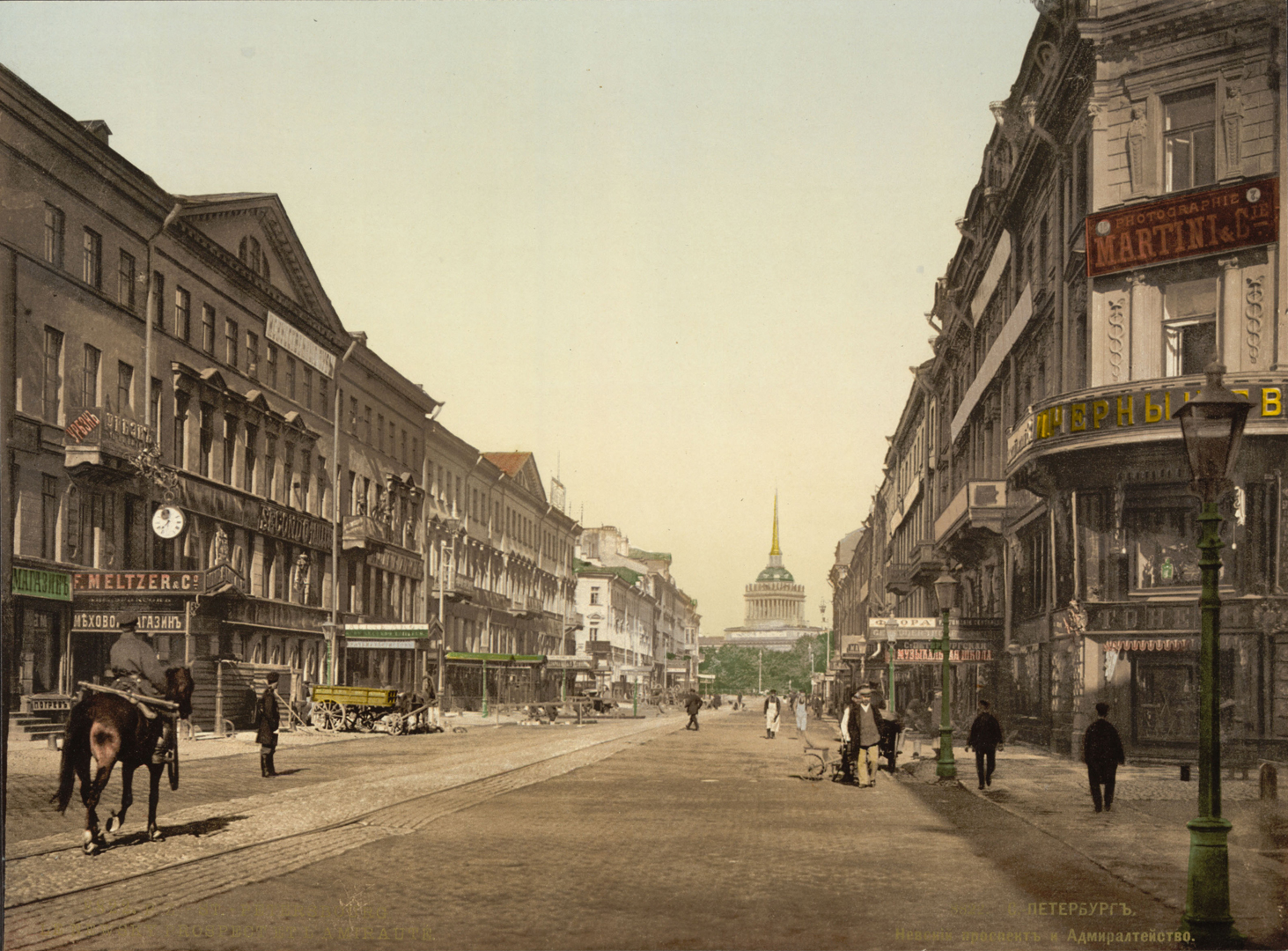
The history of Nevsky Prospect in St. Petersburg. Russia.


Nevsky Avenue (Prospect) is the main street in the city of St. Petersburg, Russia. Planned by Peter the Great as beginning of the road to Novgorod and Moscow, the avenue runs from the Admiralty to the Moscow Railway Station and, after making a turn at Vosstaniya Square, to the Alexander Nevsky Lavra.
The chief sights include the Stroganov Palace, the huge neoclassical Kazan Cathedral, 
This is theSketchUp 3D model of the Kazan Cathedral.

the Art Nouveau Bookhouse (Dom Knigi), Elisseeff Emporium, half a dozen of 18th-century churches, a monument to Catherine the Great, the Anichkov Bridge with its horse statues and much more. The feverish life of the avenue was described by Nikolai Gogol in his story "Nevsky Prospekt". Fyodor Dostoevsky often employed the Nevksy Prospekt as a setting within his works, such as "Crime and Punishment" and "The Double: A Petersburg Poem".

The view of the Nevsky Prospeсt from the Admiralty (1753).

This is the plan of St. Petersburg by I. Homann. ( 1720). 

View of Palace Square from Nevsky Prospeсt (1804).

Nevsky Prospect. Early 19th century.

Nevsky Grand Gostiniy Dvor (1910).

The Nevsky Prospect (1900).

Monument to Alexander III on Znamenskaya Square. (1910).

The Nevsky Prospeсt (1912).

The Nevsky Prospeсt f (1900).

The Nevsky Prospeсt near the Nicholas Railway Station (1890).


The Nevsky Prospect in 1901.