Показаны сообщения с ярлыком model. Показать все сообщения

среда, 15 мая 2013 г.

The General Staff Building is situated on Palace Square in Saint Petersburg, Russia in front of the Winter Palase.

The General Staff Building is situated on Palace Square in Saint Petersburg, Russia in front of the Winter Palace.
The description of General Staff Building is below.
The building was designed in 1819-1829. It consists of two wings, which are separated by a tripartite triumphal arch. It commemorating the Russian victory over Napoleon in 1812. The arch links Palace Square through Bolshaya Morskaya St. to Nevsky Prospekt. The western wing now hosts the headquarters of the Western Military District of the Russian Army. The eastern wing was transferred to the Hermitage Museum in 1993.
This is the view of Palace Square and the General Staff Building in St. Petersburg. Russia.
You can see the Google Earth model of this building on:
http://sketchup.google.com/3dwarehouse/details?mid=191d0f53f89647f66f5cabd5204b081a&ct=mdrm&prevstart=540

Арка была построена как главный и завершающий монумент, посвящённый Отечественной войне 1812 года. К. Росси, проектируя главную площадь молодой столицы, решил связать два крыла Главного штаба триумфальной аркой
For more information, visit:


The view of the General Staff Building from the Palace Square (1820).

Portrait of Italian architect Carlo Rossi (1820).
The General Staff Building at present time.

понедельник, 26 ноября 2012 г.

The Bestuzhev Courses were the largest and most prominent women's higher education institution in Imperial Russia.

The Bestuzhev Courses were the largest and most prominent women's higher education institution in Imperial Russia. 
The Courses opened its doors in 1878. It was named after Konstantin Bestuzhev-Ryumin, the first Director. The most famouse professors of the Bestuzhev Courses were Alexander Borodin, Faddei Zielinski, Dmitry Mendeleyev, Ivan Sechenov, and Sergey Platonov. A building for Bestuzhev Courses on the 10th Liniya (Line) of Vasilevsky Ostrov (Island) was built in 1885 on a draft of Academician of Architecture A. Krasovsky. 
Bestuzhev courses in St. Petersburg. 1878-1918
Konstantin Bestuzhev-Rumin (1829 - 1897)
Initiators of foundation of High Women's (Bestuzhev's) Courses. (1890).
Professor of Physics and Mathematics Faculty of the Courses Ivan Meshchersky among girl students (1914).
Female students of the courses were called "Bestujevka". 
Female students of the courses.
The girl students in the physics laboratory (1913).
The Library of the Bestuzhev Courses now (2012).
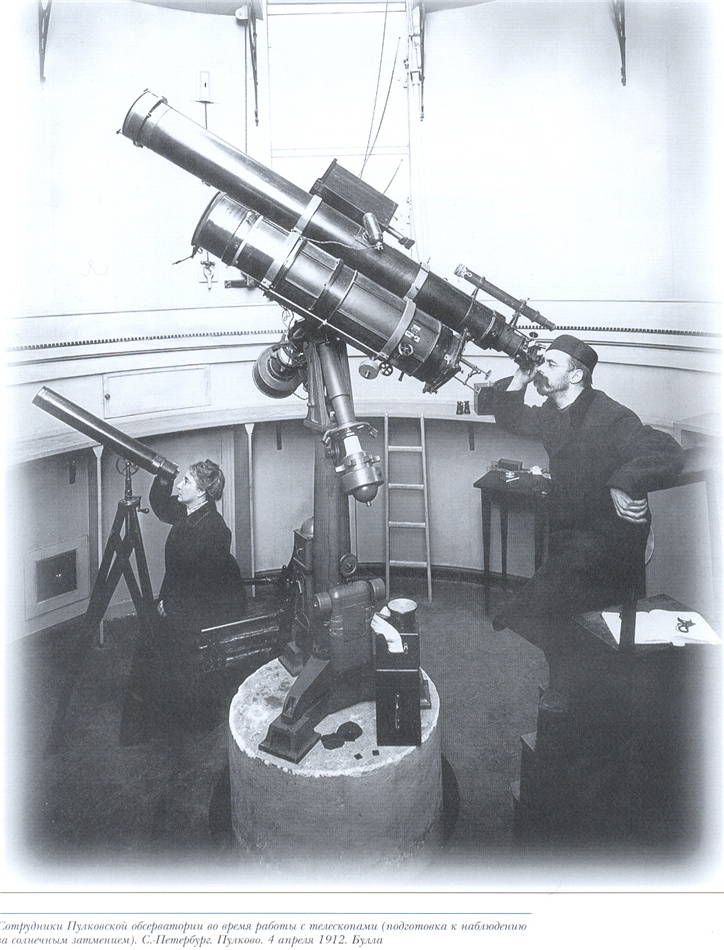
The new observatory of the Bestuzhev Courses (1912).

The Bestuzhev Courses were on the 10th Line of Vasilevsky Ostrov (Island) and some girl students rented room on 8th Line and then in the very nice building on 14th Line.
Bestuzhev Courses building now. (2012).

The old building of Moscow Exchange on Ilyinka Street in the center of Moscow.

Ilyinka is a very old street in the center of Moscow. There is very old building of the Moscow Сommodity and Stock Exchange.
There his is 3D model of Moscow Exchange Builbing.
The Ilinka Street runs from the Kremlin to the ancient walls of Kitai Goroda.
Kitai Gorod (China Town) is the oldest district of Moscow. 
The Moscow Exchange building was an architectural monument of the second half of XIX century. It was built in 1873-1875 by architect A. Kaminski in the style of late eclecticism.
The Moscow Exchange has evolved primarily as a Commodity Exchange. The main commodity were cotton, cotton yarn, muslin. Some later the list was added with oil, coal and minerals.
The Moscow Exchange building in 1839
The Moscow Exchange building in 1880.
View from the Market Square.
The old building of Moscow Exchange now.
The street address is: Moscow, Ilyinka Street, 6/1. 
The Chamber of Commerce of Russia is located in this building now.

The history of the Kuznetsky Most street in the center of Moscow.

Kuznetsky Most is the street in the center of Moscow, This street runs from Bolshaya Dmitrovka Street to Lubyanka Street. The name (literally BlackAsmith's Bridge) refers to the 18th century bridge over Neglinnaya River.
The is Kuznetsky Most street in the XVIII century. 
This is SketchUp model of old building of Trading House Muir and Mirrielees which was opened on Kuznetsky Most street in 1892.
This is Kuznetsky most and Cannon yard in the XVI century. 
( by A.Vasnetsov).
This is the mouth of the Neglinka river and Kuznetsk Most (bridge) in the сenter of Moscow.
The engraving after a drawing of Mr. Larry J. Delabarta 1796
In 1754 three-span wooden bridge was replaced in the white stone.
In 1986 the bridge was accidentally dug up during installation of heating. 
It is the former bed of the river Neglinka.
The Kuznetsk Most (bridge) was here. 
Kuznetsky Most street (1834). 
Kuznetsky Most street in the middle of 19 century.
Kuznetsky Most street during the coronation of Nicholas II (1896).
This is the Flag Day. This is the action for the collection of the money for the victims of War. Kuznetsk Most (bridge). 1914 
Kuznetsky Most street (1903). 
Church of the Vedenija v Pskovichah (The Presentation of the Blessed Virgin Mary) on Kuznetsky Most street was built in 1514-1517 and demolished in 1924. 
The place where was demolished church of the Vedenija v Pskovichah now. (June 2012). 
Kuznetsky Most Street now.

суббота, 24 ноября 2012 г.

The history of Nevsky Prospect in St. Petersburg. Russia.


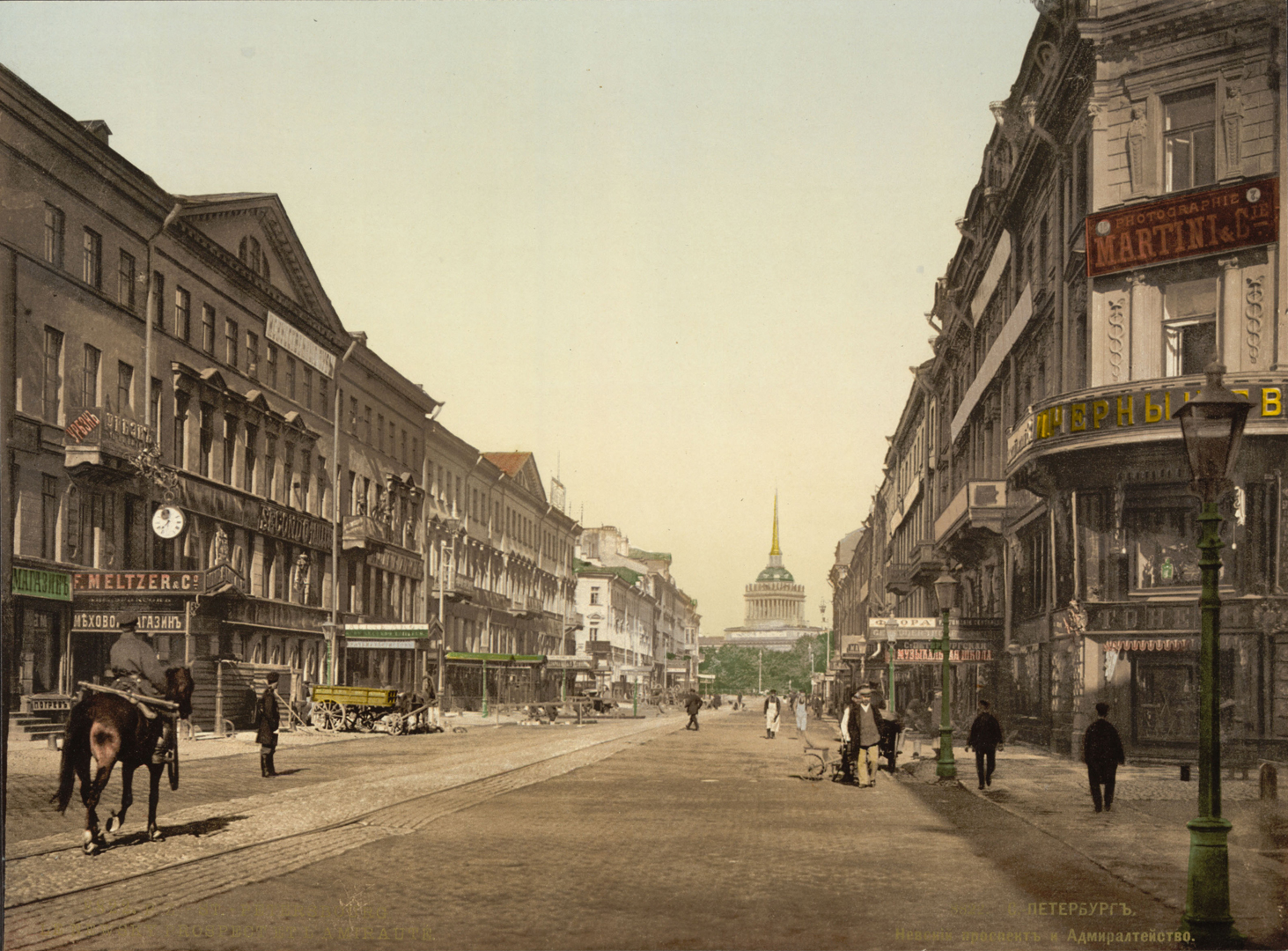
Nevsky Avenue (Prospect) is the main street in the city of St. Petersburg, Russia. Planned by Peter the Great as beginning of the road to Novgorod and Moscow, the avenue runs from the Admiralty to the Moscow Railway Station and, after making a turn at Vosstaniya Square, to the Alexander Nevsky Lavra.
The chief sights include the Stroganov Palace, the huge neoclassical Kazan Cathedral, 
This is theSketchUp 3D model of the Kazan Cathedral.

the Art Nouveau Bookhouse (Dom Knigi), Elisseeff Emporium, half a dozen of 18th-century churches, a monument to Catherine the Great, the Anichkov Bridge with its horse statues and much more. The feverish life of the avenue was described by Nikolai Gogol in his story "Nevsky Prospekt". Fyodor Dostoevsky often employed the Nevksy Prospekt as a setting within his works, such as "Crime and Punishment" and "The Double: A Petersburg Poem".

The view of the Nevsky Prospeсt from the Admiralty (1753).

This is the plan of St. Petersburg by I. Homann. ( 1720). 

View of Palace Square from Nevsky Prospeсt (1804).

Nevsky Prospect. Early 19th century.

Nevsky Grand Gostiniy Dvor (1910).

The Nevsky Prospect (1900).

Monument to Alexander III on Znamenskaya Square. (1910).

The Nevsky Prospeсt (1912).

The Nevsky Prospeсt f (1900).

The Nevsky Prospeсt near the Nicholas Railway Station (1890).


The Nevsky Prospect in 1901.