Показаны сообщения с ярлыком Winter Palace. Показать все сообщения

понедельник, 24 февраля 2014 г.

My visit of the historical apartment of the famous Russian poet Alexander Blok in St.-Petersburg.

Музей-квартира А. Блока в Санкт-Петербурге находится по адресу: Санкт-Петербург, улица Декабристов д. 57.
Вот как выглядит лестница этого старого доходного дома.
Музей Блока был открыт 28 ноября 1980 года в доме, где А.А. Блок прожил 9 лет — с июля 1912 года до своей смерти в августе 1921 году. После смерти поэта его архив, библиотека и собрание личных вещей сохранялись его женой. После её кончины они были переданы в Институт русской литературы Академии Наук СССР, где частично экспонировались в 1960—1970-х годах.
Музей состоит из двух частей: мемориальной квартиры на 4-м этаже, созданной на уникальных подлинных предметах обстановки и убранства, принадлежавших поэту,
и литературной экспозиции на 2-м этаже, рассказывающей о его жизни и творчестве.
В доме на Офицерской, 57 (сейчас — Декабристов, 57) А. Блок жил, занимая последовательно две квартиры, с 24.06.1912 до смерти. К столетию со дня рождения поэта, в ноябре 1980 года, здесь был открыт музей-квартира. В музее открыты для просмотра три экспозиции — мемориальная (квартира № 21), литературная (квартира № 23) и экспозиция «Блок и его окружение», открытие которой состоялось в 2008 году (в квартире № 21).

среда, 15 мая 2013 г.

The General Staff Building is situated on Palace Square in Saint Petersburg, Russia in front of the Winter Palase.

The General Staff Building is situated on Palace Square in Saint Petersburg, Russia in front of the Winter Palace.
The description of General Staff Building is below.
The building was designed in 1819-1829. It consists of two wings, which are separated by a tripartite triumphal arch. It commemorating the Russian victory over Napoleon in 1812. The arch links Palace Square through Bolshaya Morskaya St. to Nevsky Prospekt. The western wing now hosts the headquarters of the Western Military District of the Russian Army. The eastern wing was transferred to the Hermitage Museum in 1993.
This is the view of Palace Square and the General Staff Building in St. Petersburg. Russia.
You can see the Google Earth model of this building on:
http://sketchup.google.com/3dwarehouse/details?mid=191d0f53f89647f66f5cabd5204b081a&ct=mdrm&prevstart=540

Арка была построена как главный и завершающий монумент, посвящённый Отечественной войне 1812 года. К. Росси, проектируя главную площадь молодой столицы, решил связать два крыла Главного штаба триумфальной аркой
For more information, visit:


The view of the General Staff Building from the Palace Square (1820).

Portrait of Italian architect Carlo Rossi (1820).
The General Staff Building at present time.

суббота, 24 ноября 2012 г.

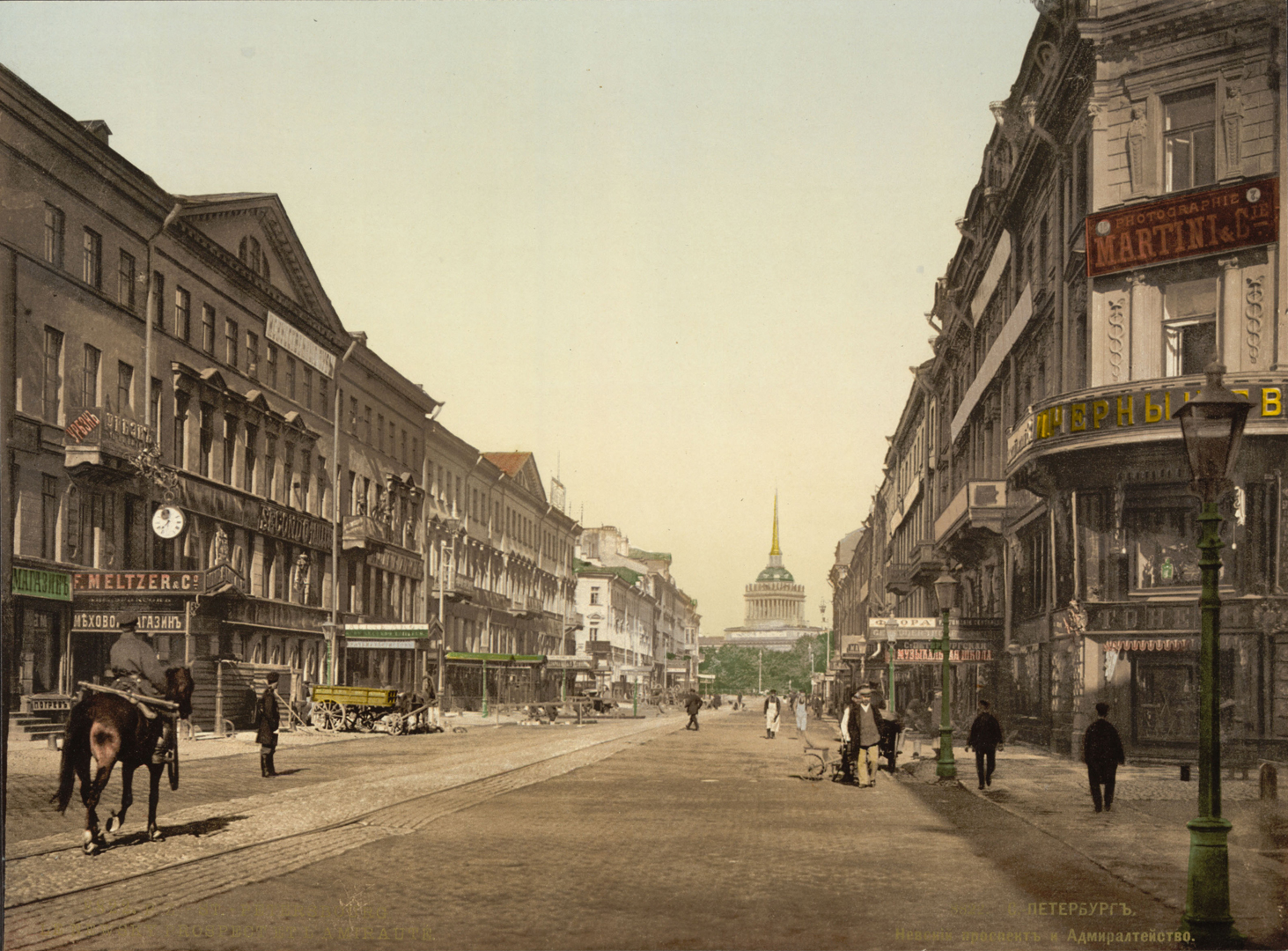
The history of Nevsky Prospect in St. Petersburg. Russia.


Nevsky Avenue (Prospect) is the main street in the city of St. Petersburg, Russia. Planned by Peter the Great as beginning of the road to Novgorod and Moscow, the avenue runs from the Admiralty to the Moscow Railway Station and, after making a turn at Vosstaniya Square, to the Alexander Nevsky Lavra.
The chief sights include the Stroganov Palace, the huge neoclassical Kazan Cathedral, 
This is theSketchUp 3D model of the Kazan Cathedral.

the Art Nouveau Bookhouse (Dom Knigi), Elisseeff Emporium, half a dozen of 18th-century churches, a monument to Catherine the Great, the Anichkov Bridge with its horse statues and much more. The feverish life of the avenue was described by Nikolai Gogol in his story "Nevsky Prospekt". Fyodor Dostoevsky often employed the Nevksy Prospekt as a setting within his works, such as "Crime and Punishment" and "The Double: A Petersburg Poem".

The view of the Nevsky Prospeсt from the Admiralty (1753).

This is the plan of St. Petersburg by I. Homann. ( 1720). 

View of Palace Square from Nevsky Prospeсt (1804).

Nevsky Prospect. Early 19th century.

Nevsky Grand Gostiniy Dvor (1910).

The Nevsky Prospect (1900).

Monument to Alexander III on Znamenskaya Square. (1910).

The Nevsky Prospeсt (1912).

The Nevsky Prospeсt f (1900).

The Nevsky Prospeсt near the Nicholas Railway Station (1890).


The Nevsky Prospect in 1901. 

The Winter Palace in St. Petersburg, Russia was the official residence of Russian monarchs from 1732 to 1917.

The Winter Palace in St. Petersburg, Russia was the official residence of Russian monarchs from 1732 to 1917. It is Situated between the Palace Embankment and the Palace Square. 
You can look at SketchUp model of The Winter Palace in GoogleEarth System.
The palace was constructed on a monumental scale that was intended to reflect the might and power of Imperial Russia. From the palace, the Tsar ruled over 22,400,000 square kilometres (8,600,000 sq mi) (almost 1/6 of the Earth's landmass) and over 125 million subjects by the end of the 19th century. It was designed by many architects, most notably Bartolomeo Rastrelli, in what came to be known as the Elizabethan Baroque style. 
The green-and-white palace has the shape of an elongated rectangle, and its principal façade is 250 m long and 100 ft (30 m) high. The Winter Palace has been calculated to contain 1,786 doors, 1,945 windows, 1,500 rooms and 117 staircases. 
The rebuilding of 1837 left the exterior unchanged, but large parts of the interior were redesigned in a variety of tastes and styles, leading the palace to be described as a "19th-century palace inspired by a model in Rococo style."
The Winter Palace in St. Petersburg under Peter I.
In 1711. 
This is the view of the Winter Palace from the Neva River. (1853). 
The view of the Palace Square and Winter Palace in St. Petersburg (1847).
The view of the Palace Square and Winter Palace in St. Petersburg (1847). 

Vasily Sadovnikov

The view of the Winter Palace from the Admiralty (1814) 
H. M. Emperor Alexander III reviewing the Horse Guards in Winter Palace Place, in St. Petersburg. At the head of the regiment is H. I.H. Grand Duke Paul of Russia, commander of the Horse Guards. Reproduced from an oil painting by Mazurowski belonging to the picture gallery of the Emperor Alexander III Museum, St. Petersburg.
SPB Palace square and Alexander's column 1890-1900
In 1905, the Bloody Sunday massacre occurred when demonstrators marched toward the Winter Palace, but by this time the Imperial Family had chosen to live in the more secure and secluded Alexander Palace at Tsarskoe Selo, and returned to the Winter Palace only for the most formal and rarest state occasions. Following the February Revolution of 1917, the palace was for a short time the seat of the Russian Provisional Government, led by Alexander Kerensky. Later that same year, the palace was stormed by a detachment of Red Army soldiers and sailors—a defining moment in the birth of the Soviet state. On a less glorious note, the month-long looting of the palace's wine cellars during this troubled period led to what has been described as "the greatest hangover in history". Today, the restored palace forms part of the complex of buildings housing the Hermitage Museum. 
The coach of the imperial family at the entrance of the Winter Palace (1914). 
The declaration of war on 20 July 1914.